Friday, June 26, 2020
Teeth (the movie)
I know I watched this film about a chaste teenage girl who discovers that she has vagina dentata at least two times before, but those were obviously before I started this blog. I read something recently that indicated a library connection and so I put it back on my Netflix DVD list.
When Dawn (Jess Weixler) suspects something is different about her body she does what anyone in the 21st century would do and begins her research by conducting a web search. She types "female genital mutilations" into the search engine which lands her a screenful of results. However, unlike everyone else she doesn't just click on the top link, but rather selects the the trusty link from the public library "your source to information". It is not clear if the link is from the Austin (TX) public library where the story takes place. It seemed more to be a generic public library link.
Definitely not a film for the squeamish. It will likely appeal to fans of Little Shop of Horrors.
Wednesday, June 17, 2020
La biblioteca mágica - por Valeria Cavajal Vasco
According to amazon I bought this book on April 30, so I must have purchased it for Día de los niños/Día de los libros (aka "Día" or Children's Day/Book Day). I do recall specifically looking for a library-centric, Spanish-language book to read. I usually pick a picture book to blog about for Día but this year I selected a chapter book, so it took me a bit longer to read it. This is the story of friends Emma, Park, Paige, and Liam who want to take a summer vacation together, but first they need to earn some money. Paige and Park find work at a local store, and Liam gets a job with his uncle. Emma is worried that she will be the only one who won't be earning any money, until her mother helps her land a job at the local library el "único lugar al que muy pocos adolescentes irían a pedir trabajo", as well as "el lugar más aburrido del pueblo" (for those who are Spanish-language challenged, that translates to 'the only place that few adolescents would ask for work'; and 'the most boring place in town').
Emma, however, discovers that the library is far from boring. In a library lover's version of Night at the Museum Emma learns that those who work the night shift have the ability to visit the characters in the books. Beginning with Caperucita roja (Little Red Riding Hood), she moves on to Peter Pan, Harry Potter; and Crepúsculo (Twilight), among others. From each book she also brings back a souvenir (Red Riding Hood's Cape and Peter Pan's sword, for instance). Far from boring, Emma finds that she not only looks forward to going to work in the library she is more interested in her work than in hanging out with her friends. She is reluctant to tell them about the library's secret until she learns that the mayor wants to close the library because nobody visits it, and it isn't a money maker. With the help of her friends and the other library employees, she comes up with a plan to save the library.
I must say I was left a little wanting with the resolution they came up with which I saw as stop gap at best, and had nothing to do with magic. No one wanted to reveal the library's secret for fear of exploiting it. However, if I were writing the ending to this book the friends would have sparked interest in the library, and helped it to make money without letting anyone in on the secret by strategically visiting books, bringing back cool relics, and selling them. In fact I thought this solution was so obvious I really was stunned that it wasn't how the book ended.
Monday, June 1, 2020
Nothing to See Here - by Kevin Wilson
When her frenemy Madison Roberts contacts Lillian Breaker and asks her to come to Tennessee from her home in Pennsylvania, offering her a mysterious job, Lillian accepts. She takes the bus to Nashville where she is met by the enigmatic Carl who works for Madison and her senator husband, Jasper. Upon arrival at the estate where Madison lives with her toddler son (Timothy) and husband Lillian learns that the senator has two children (twins) from a previous marriage, whose mother had recently killed herself. The twins (Bessie and Roland) have an unusual affliction wherein they burst into flames when upset. The fire does not hurt them, but can be dangerous to people, animals and things near them. They are coming to live with Madison, Timothy, and Jasper. Madison wants Lillian to be their governess. Fortunately for Lillian the twins like to read. In fact, as Roland points out to Lillian when he first saw the well stocked bookcase Madison provided for the twins "all we do is read". And although Bessie informs Lillian that she'd already read many of the books on the shelf some of them looked "pretty good". Lillian wastes no time in telling them that they can get more books at the library.
And good on her promises, Lillian asks Carl to drive them all on an outing to the library so they can research famous Tennesseans. Bessie chooses Dolly Parton and Roland decides on World War II hero Sargeant Alvin York. They find the books they want when they get to the library, but soon realize that none of them has a library card. Carl points out that that they need proof of address "like a piece of mail" to get one, and none of them have a piece of mail with them. It seems to me that Carl must have had a driver's license but he never suggests that. He does tell them that Madison is on the Board of Trustees and that they can come back later with her card. Instead they just decide to steal the books. I expect that if they had simply asked to call the senator's wife, who was also a library board member, they could have gotten permission to check the books out, but no one thought of this solution.
It is always best to ask about policies for checking out books. Librarians really do want you to get the information you need.
Wednesday, May 13, 2020
The Book of M - by Peng Shepherd
May is Mystery Month and I don't really like mysteries. I especially don't like the serial mysteries that involve some amateur sleuth in a small town with a disproportionate number of murders. It seems like a lot of library mysteries are of this type. People keep recommending them to me, and I keep not liking them. However, I do like to have a variety of genres on this blog, so I googled library mysteries and found this title. The description appealed to me because it looked supernatural, surreal, and, most decidedly, not part of a murder series. If you are a person who likes this genre I do have some posts which you can find here and here.
It turned out that much of what takes place in this dystopian novel is rather prescient. A mysterious disease causes people to lose their shadows, and eventually their memories. Quarantines, food shortages, suspicion and fear abound. Shadowless people not only lose their own memories, but memories of virtually everything. Some don't remember how to eat, to read, or to talk. Women don't understand what their periods are (and as a bonus have no idea that they'd been taught to be ashamed of them). Shadowless also eventually forget that there are laws of physics, and once they forget that, they can simply ignore those laws. People can mutate themselves and others; prison cells become their own means of escape.
I read quite a bit of this without seeing anything about a library, so I naturally grew concerned that I'd been duped. Fortunately, I was reading an e-version of the book which allowed me to search easily for the word library to find out if indeed this were a library-centric book. Although the first instance of the word doesn't show up until about 40% in, it then becomes quite important. The Martin Luther King, Jr. Memorial Library in Washington, DC is the location of a battle for books between the shadowed and the shadowless. Of no surprise to this librarian the books ultimately prove to be the salvation of all.
Wednesday, April 29, 2020
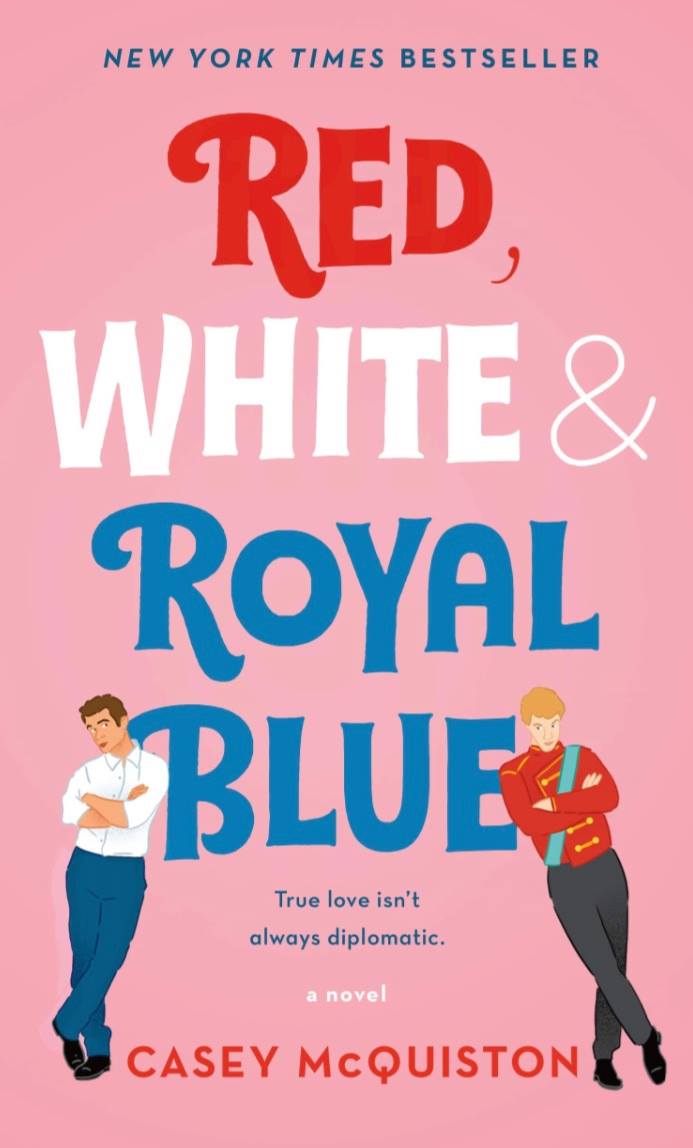
Red, White & Royal Blue - by Casey McQuiston
The Buck(ingham) Stops Here!
James and I read about this book on some listicle back in February while we were on our way to Martha's Vineyard. I remember the description said something about this being covered all over the place during the summer of 2019 and if you didn't know about this love story between the Prince of Wales and the First Son of the United States you weren't paying attention. I really don't know how I missed it. I see the book trade magazines regularly come across my desk, and this is exactly the kind of book that would have caught my eye. But here we are.
Anyway, since the trip to the "Vineyard" was pre-pandemic the local bookstore (Bunch of Grapes) was still open. We went in and purchased it with the intent that we would read it together. The story takes place in the present day in a parallel universe in which there is no pandemic, and the country isn't being run by a completely incompetent president.
What starts as a bro-mance orchestrated for the press turns into a full on love affair when the biracial, bisexual son of the first woman president of the United States falls for Henry, the gay Prince of Wales. Not prepared to come out to their families, much less the rest of the world, the two manage their long-distance romance by making up reasons to hop across the Big Pond, as well as via chat messages and e-mail. When their steamy electronic messages get leaked to the press the two find themselves in a true diplomatic nightmare for the White House and the Crown. Can these two millennials make history with an international sex scandal?
The real nail biter for me, though, was wondering if these two would ever use a library. James and I very much enjoyed reading this, and I was truly worried that it would not find a place on this blog, as the first time a library is even mentioned is not until page 386 (of 418) and that was simply as a place that was nixed as venue for the official royal "courtship photos".
Alex has to admit, the royal photographer is being exceedingly patient about the whole thing, especially considering that they waffled through three different locations-Kensington Gardens, a stuffy Buckingham Palace Library, the courtyard of Hampton Court Palace-before they decided to screw it all for a bench in a locked-down Hyde Park.There is a nod to the intellect of these two by way of "a pile of books" stacked up next to the bench in the photos. The use of the indefinite article in front of "stuffy Buckingham Palace" caused James to wonder aloud just exactly how many libraries there are in the palace, and for me to follow up with, "and just how many of those are stuffy?"
Interestingly, after making me wait until the book was almost done to satisfy my frustration, the author manages to sneak in one more mention of a library - the Library of Congress of course - on page 415.
This is truly a fun romance about a well-matched pair. Equal in good looks, intellect, and political power there's no trite story about a prince pretending to be just a regular guy, or a poor admirer hoping the prince will notice them. Only the use of a library could have formed a more-perfect union between these two.
We started reading this just about the time that our governor issued the stay-at-home order for Massachusetts, and we read a bit each day. It was the perfect antidote to our work-at-home days - a little daily vacation when we could forget about what was going on in the rest of the world and simply have a laugh together.
Sexy, smart satire. Read it with someone you love.
Tuesday, April 21, 2020
Veronica Mars - great detective, lousy librarian
I missed the Veronica Mars television series when it first aired from 2004-2007. I doubt I even knew it existed. Back then, before there was streaming television, people had to subscribe to a cable service if they wanted to watch TV, and my husband and I refused to pay for it. The only thing we watched on the boob tube were videos available at our local Blockbuster video store. We now subscribe to Netflix and Hulu which is how I was able to binge watch this smart, sassy show about a young woman who works for her father - a Private Detective. The first two seasons we see Veronica as a high school student. In season three she is a freshman at the fictional Hearst College where she gets a job at the college library. She is disappointed at this appointment, as she feels it is inferior to working for the school newspaper, and her letdown is evident in the crappy way she answers questions. She often appears annoyed, and waves people off to the stacks rather than attempting to do a proper reference interview. Worst of all, she closes the reference desk when her boyfriend shows up so she can go bone him on the ninth floor.
The recently-made fourth season features a grown up Veronica still working with her father at his Detective agency. It also features a reference librarian from the Hearst College library. The librarian has a bit part, and is unimpressed when Veronica points out that she, herself, used to work in the library. Maybe the librarian knew her then, and was aware that she wasn't the best student worker they'd ever had.
Anyway, despite the obvious drawbacks I enjoyed this series. Veronica seriously kicks butt.
Tuesday, April 7, 2020
The Influencing Machine - by Brooke Gladstone, illustrated by Josh Neufeld
Fans of National Public Radio know Brooke Gladstone from the program On the Media. I noticed this graphic non-fiction on a display created by one of my co-workers. Although it is almost 10 years old the messages about how the media influence public opinion are still quite relevant. This book covers history, politics, censorship, bias, echo chambers, misinformation, and the changing nature of the news cycle with good humor in an easy-to-digest format.
Ultimately, what this book is about is information literacy - tracking down sources, verifying sources, and rejecting bad sources. Gladstone explains how bad information can become part of the collective consciousness simply by being repeated by people who don't know anything about it. Furthermore she demonstrates and that it is not always good journalism to provide both sides of an issue if one side is misinformed. She also explains that too much information (information overload) can be harmful. This is not a new concern, and she points to a story in Plato's "Phaedrus" in which "Socrates derides the invention of writing with a story of the Egyptian god who invented the alphabet brags to a king" who reponds that "this discovery...will create forgetfulness in the learners' souls-they will trust to the external written characters and not remember of themselves". Likewise Gutenberg's printing press had bibliogrpaher Conrad Gesner complaining of the "confusing and harmful abundance of books". Gesner in compiling the Universal Library decided only to include books written in Greek, Latin, and Hebrew.
This of course is where librarians come in. As "media theorist Clay Shirky says many people confuse information overload with filter failure". Catalogers, librarians, news aggregators, and other databases services already have those filters in place. Librarians can help people to navigate to the right resources for their information needs.
Subscribe to:
Posts (Atom)