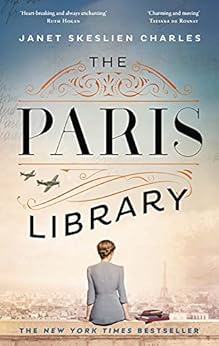
Numbers floated round my head like stars. 823. The numbers were the key to new life. 822. Constellations of hope. 841. In my bedroom late at night, in the morning on the way to get croissants, series after series - 810,840,890-formed in front of my eyes. They represented freedom, the future.
Wednesday, September 15, 2021
The Paris Library - by Janet Skeslien Charles
Friday, September 10, 2021
My Brilliant Friend - by Elena Ferrante
This coming of age story follows best friends Elena and Lila as they grow up outside of Naples, Italy in the 1950s. The two girls are the smartest in their class at school. While Elena is provided the opportunity to continue with her formal schooling beyond grammar school, Lila realizes that she must continue her education at "the people's university" - the public library. She figures out that she can borrow a lot more books than would normally be allowed by procuring library cards for everyone in her family, and then using them only for herself. Everyone in Lila's family is later invited to the library to be honored for being such avid readers. It would appear that Lila, her brother, mother, and father have come in first, second, third, and fourth for the most books read. Elena is also invited to the recognition ceremony for coming in fifth. No one from Lila's family (including Lila) comes to the ceremony and Elena accepts the awards for all.
The first book in a four-part series. This has also be adapted for television - currently available on HBOMax.
Tuesday, September 7, 2021
D.W.'s Library Card - by Marc Brown
Monday, August 30, 2021
Too Much and Never Enough - by Mary Trump
Beyond a "tell all" the forty-fifth president's niece provides a deep insider's knowledge of the Trump family through a psychological lens in this bestselling book. Not surprisingly, there was no mention of the young Trump family heading to the public library for story hour, in fact the only library mentioned is the one in "the House" (the residence where Donald and his four siblings grew up in Queens, New York). I probably wouldn't have bothered at all to create a blog about this except that the description of said library is so telling. About halfway through the book Mary provides this tidbit
When the family was together, we spent most of our time in the library, a room without books (emphasis mine) until Donald's ghostwritten The Art of the Deal was published in 1987. The bookshelves were used instead to display wedding photos and portraits.
Well there you have it. A whole room that could have been dedicated to books but wasn't. I must say, I'm not surprised.
Saturday, August 28, 2021
A Ride to Remember: A Civil Rights Story - by Sharon Langley and Amy Nathan
When I was very young my family and I enjoyed visits to Gwynn Oak Amusement Park in Baltimore, Maryland. Hurricane Agnes destroyed the park in 1972 and it was not rebuilt. Rather than an amusement park, it now is a park of the type one might go for a picnic, or to fly a kite.
For a long time, black and white kids couldn't do many things together. They couldn't go to the same schools or to the same restaurants and libraries or even sit together at the movies. It was the law."Why didn't somebody do something about those kinds of laws?" I asked."They did," said Mama."We did," said Daddy.Many people - both blacks and whites - knew that segregation was unfair and just plain wrong.Some people said, Just wait. Times will change.But others said, Why wait? What's wrong with now? They held protests at restaurants, stores, and movie theaters. They tried to get officials and courts to make new laws to create a better city - a place that would welcome and include all people.By the time I was born, some unfair laws had changed in Baltimore. Kids could go to the same schools and libraries, restaurants, and some movie theaters, too - no matter the color of their skin. "But the amusement park just wouldn't budge," said Daddy.
Monday, August 16, 2021
The Book of Joy - by His Holiness the Dalai Lama, Archbishop Desmond Tutu, and Douglas Abrams
so they burned books, such as the three-hundred-volume Tibetan canon of scriptures translated from India, as well as several thousand volumes written by Tibetans themselves
As our motorcade approached, we heard the children's soaring voices, their welcome song high-pitched and plaintive, yet indomitable and joyful. It was a song they had composed...The choir and school staff lined the road. All around them sat waves of students in their school uniforms...The car finally arrived at the library and the children were still singing at the top of their lungs.
This was, ironically, a rather challenging book for me. As I read news of building collapses, an earthquake, the Taliban, raging wildfires, all while facing a pandemic that won't slow down because of deliberate manipulation of truth, perhaps remaining hopeful is the best I can do for now. Joy will have to wait.
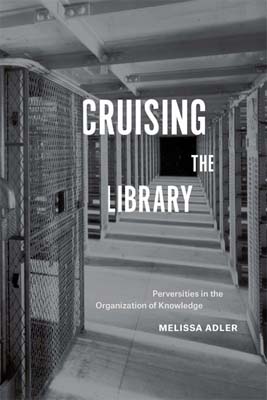
Cruising the Library - by Melissa Adler
I noticed the title of this book while I was looking for something else in our library catalog. (I don't remember what I was originally searching.) The author begins with a discussion of the Library of Congress catalog subject term "Paraphilias" - a word I had never heard of before reading this book, which is exactly her point. Very few people know this word, and even if they could guess its meaning, they probably wouldn't think to search for it in the library catalog even if they had heard of it. Using the word as a subject heading effectively hides the work even as it is available on the open shelves of the library.
(At the time of this posting my own library had six titles listed under the subject heading Paraphilias.)
Through the exploration of this term Adler demonstrates that how we classify books has more to do with librarians determining what is "normal" (rather than simply reflecting it) especially when it comes to sex. Furthermore, the Library of Congress
disciplines sex and sexuality by privileging scientific domains and text, granting such disciplines authority while obfuscating the humanities, popular literature, and emerging interdisciplinary and local knowledges.
She also demonstrates how whiteness and heterosexuality are presumed "normal" by searching the catalog for specific terms.
Much of this book is an exploration of the now defunct Delta collection of the Library of Congress - a little known collection of erotica, works deemed obscene, or those containing information about "perverse" or "aberrant" sexual practices. The Delta collection was restricted - those wishing to use it had to ask. By putting certain works in the Delta collection librarians had power in determining what was considered obscene or "aberrant". Now long gone, Adler discovered that even finding information about the existence of the Delta collection was hard to come by. An excerpt from her book about the collection was published on Literary Hub (which you can read here).
Those of us who work in libraries are no strangers to the use of the library as sexual space. Many a library worker can tell you a story of coitus interruptus or of finding post-coital evidence while straightening books the stacks. Adler also sees the library itself as a sensual and seductive place
The library is an erotically charged space. Some might even regard the pleasurable experience of browsing and losing and finding oneself in the stacks as an exercise in sadomasochism. The classificatory apparatuses in the library, with their disciplinary divisions and regularizing and shaming techniques, often bar opportunities for cross-disciplinary play, prohibit the intermingling of bodies, and cut the perverse from the normal (as if such an act was actually possible). In the library space, submission to and enactment of technologies of control facilitate and inhibit promiscuousness in browsing, perverse reading, and bodily pleasures.
I am always interested in what people have to say about book banning. Adler quotes President Dwight D. Eisenhower who had this to say about it in 1953
Don't join the book burners. Don't think you are going to conceal faults by concealing evidence that they never existed. Don't be afraid to go into your library and read every book.
Be like Ike.