Friday, April 29, 2022

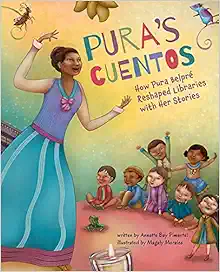
Pura's Cuentos: How Pura Belpré Resphaped Libraries with her Stories


In honor of Día of los libros/Día de los niños I read yet another book about Pura Belpré, New York City's first bilingual librarian. Bright illustrations of coquí frogs, mangos, mice and cockroaches show how the stories about Puerto Rico are just as vibrant as the stories of New York City with its fabulous music and dance scene.

Pura knows, too, that stories that are not written down can be just as exciting as stories in books, and that stories in all languages should be told. Everyone has stories to tell and hearing other peoples' stories will make us all richer. 

Written primarily in English there is Spanish vocabulary sprinkled throughout. A story for all about stories for all.

See also Sembrando historias and The Storyteller's Candle/La velita de los cuentos.

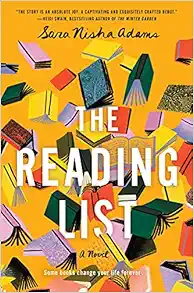
The Reading List - by Sara Nisha Adams


Libraries change lives. The books we read, the people we meet, the physical space, the programs all create the magic, and community of the library. 

When indifferent library worker Aleisha finds a reading list inside of a returned book she not only changes her own life by reading the eight books, she begins to make a difference in the lives of some of the other library patrons as well. Most notable among these is recently widowed Mukesh Patel, who has yet to return the long-overdue book his wife last read The Time Traveler's Wife. Although Mukesh was never much of a reader, his late wife Naina was an avid reader and library user. Through the magic of books (and the library) Mukesh finds a new connection with his beloved granddaughter Priya. It turns out they both love Louisa May Alcott's Little Women and Mukesh begins to think about everyone who is connected by the books they read.

One of the first things I learned in Library School were Ranganathan's Five Laws of Library Science. Although the rules were written almost a century ago, they remain quite relevant:
  • Books are for use
  • Every reader their book
  • Every book its reader
  • Save the time of the reader
  • A library is a growing organism 
Each of these laws is evident in this work about people connecting through books and libraries.

Wednesday, April 27, 2022

The Boy in the Field - by Margot Livesey

In the waning days of the 20th century, siblings Zoe, Matthew, and Duncan discover a stabbing victim left to die in a field, and their lives each take on a new direction, and each finds a use for the library. Teenage Zoe begins dating an Oxford University student. She masquerades as an undergraduate and discussing things such as the Bodleian Librar keeps her from blowing her cover. Matthew, in an attempt to find the perpetrator of the crime, searches for clues in the local papers at the public library. Duncan becomes curious about his birth mother and decides he wants to find her. Zoe suggests he look her up in the phone books at the library. Additionally, other uses of the library are sprinkled throughout the work.

Monday, April 4, 2022

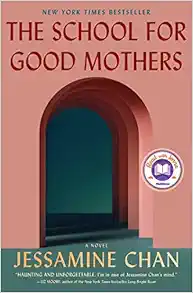
The School for Good Mothers - by Jessamine Chan


Bringing together ideas from The Stepford Wives, The Handmaid's Tale, and the movie A.I. Jessamine Chan finds a new way to scare the bejesus out of all of us.

Frida Liu is a single mother trying to co-parent her toddler (Harriet) as best she can with her ex-husband (Gust) and his live-in girlfriend (Susanna). During the Labor Day weekend Frida is unable to console the eighteen-month-old who is suffering from an ear infection. Neither is able to get much sleep over the three days. Frida, at her wit's end, leaves the house, and her daughter unattended, for two hours. The police are called when the neighbors hear the baby's incessant crying. After several months of invasive monitoring, and limited supervised visits with her daughter, Frida is sent to a facility where she can be rehabilitated as a mother. The year-long stay involves learning to parent with a creepy robot surrogate for her daughter, on a defunct university campus.

Mentions of libraries are infrequent and tend to be nefarious in nature. Frida is told not to do research at the library prior to her court hearing, lest she be monitored; the former music and dance library on the prison campus is empty; one mother is being rehabilitated for having allowed her eight-year-old to walk home from the  local library alone (a four-block distance). Frida gets one 10-minute video visit with Harriet a week which take place in the former campus library. Even these become depressing events. On the rare occasions when Frida's phone privileges aren't rescinded and she is able to connect with Harriet, Gust and Susanna, the calls are fraught.

A truly chilling tale for the twenty-first century.

Saturday, April 2, 2022

Lailah's Lunchbox: A Ramadan Story - by Reem Faruqi


In honor of Ramadan which starts today, and National Library Week, which starts tomorrow, I read Lailah's Lunchbox. In this beautifully illustrated book young Lailah is excited to be fasting for the month of Ramadan for the first time. She is worried, though, that her classmates and teachers in Peachtree, Georgia won't understand why she isn't joining them at lunch. She decides to go to the library during her lunch period where she is greeted by an understanding librarian, Mrs. Carman, who is happy to share the time with her, and to help her gather her thoughts so she can best explain why she is fasting, and why Ramadan is a special time.


Friday, March 25, 2022

The Blind Assassin - by Margaret Atwood

I do enjoy a good bit of metafiction. In the tradition of Irving Wallace's The Seven Minutes; Ann Patchett's Commonwealth; and Cornelia Funke's Inkheart Atwood's The Blind Assassin tells the story of a fictitious novel of the same name.

Laura Chase's posthumously published book (following a questionable suicide at the age of 25) has a kind of cult following. Although some love it and it was "well received in critical circles in New York and London",  others thought it 

would best be forgotten. Although it isn't...even after fifty years it retains its aura of brimstone and taboo. Hard to fathom...as carnality goes it's old hat, the foul language nothing you can't hear any day on the street corners, the sex as decorous as fan dancers...

However, even the "whimsical" sex was enough for the book banners to come out against it

What people remember isn't so much the book itself, as much as the furor: ministers in church denounced it as obscene, not only here; the public library was forced to remove from the shelves, the one bookstore in town refused to stock it. There was word of censoring it. People snuck off  to Stratford or London or Toronto even, and obtained their copies on the sly, as was the custom with condoms. Back at home they drew the curtains and read, with disapproval, with relish, with avidity and glee - even the ones who'd never thought of opening a novel before. There's nothing like a shovelful of dirt to encourage literacy. 

There are more than a few mentions of private libraries. Other libraries get a bit of ink as well. The Chase sisters, Laura and Iris (the narrator) take their lessons in their home library from a succession of governesses and other instructors following the death of their mother. The curiously named Miss Violence gave the girls the run of the library and "let us do what we liked" while she (Miss Violence) "sat by the window and read romantic novels from the lending library".

An aging Iris also considers what do with a trunk full of "notebooks...typescript...letters to publishers ... corrected proofs...[and] hate mail". Leaving this archive to a university or library where it "would be at least be appreciated...in a ghoulish way" seemed reasonable. 

There were more than a few scholars who'd like to get their claws into all this waste paper. Material [emphasis in original] they'd call it - their name for loot.

There is a somewhat surprising ending, although as Iris points out to her audience "you must have known for some time".

It took me a while to get into this book. In fact the first time I tried reading it was about twenty years ago. However, I not only finished it this time, I was sorry when it ended.

Friday, March 18, 2022

Off the Edge - by Kelly Weill

The rather long subtitle of this work is "Flat Earthers, Conspiracy Culture, and Why People Will Believe Anything". Weill immerses herself into the culture of the Flat Earthers to discover how and why they came to believe. The short answer: it's all YouTube's fault. There is of course a lot more to it, but most contemporary Flat Earthers got started by going down a YouTube rabbit hole, and once they went down they found more and more videos by other people proclaiming to have done "experiments" that prove that the world is flat. 

I must admit that until I read this book I assumed Flat Earthers were putting us on, but not so. They are indeed quite serious, and are ready to fight (some to the point of fisticuffs) with those who disagree. Evidence to the contrary is unlikely to sway those who subscribe to the Flat Earth theory. Nor does the threat of loss of companionship. Many have lost family and friends over the issue. Some have severed almost all ties with loved ones and only have the online community of other Flat Earthers for companionship. Conspiracy theorists of all stripes have, sadly, always allowed this to happen. As Weill describes the disappointment of the Millerites in the 1840s when the apocalypse failed to materialize as predicted by their leaders

...many members only became more fervent in their belief, proclaiming that the real end was still coming soon...believers let their crops rot and their friendships fail...These groups often find trivial factors to blame for their disappointments...

Libraries are at the front lines of combating misinformation, disinformation and conspiracy theories. Weill finds a topographic map in a library that refutes some psuedo-science described in a 1930 Leaves of Healing newsletter which purports that "Flat Earth belief as a matter of salvation or hellfire".

Libraries can also provide information that only intensifies the arguments of a true believer.  In 1919 Flat Earth Society founder Samuel Shenton theorized that if an aircraft hovered over the earth that it could simply wait until its destination caught up with it (since the earth spinning on its axis after all). He was vindicated when he found plans for a similar airship (created by another flat-earth believer) in a library. And, rather ironically, it was research in his local public library that led Charles K. Johnson to Shenton, and the International Flat Earth Research Society (IFERS) in the early 1940s. Johnson was able to contact another flat earth believer Wilbur Glen Voliva who "confirmed" everything Johnson believed.

As we debate how far social media should go in monitoring speech in order to combat misinformation, and as book banners across the country attempt to remove materials from schools and libraries in unprecedented numbers, the need for librarians (never mentioned in this book), who can help people navigate their research, is made abundantly clear.