Tuesday, March 3, 2020

Hazards of Time Travel - by Joyce Carol Oates


In a dystopian future, class valedictorian Adriane Strohl  is arrested for treason and "questioning authority" on the eve of her high school graduation. She is sentenced to live in Zone Nine - 1959 Wainscotia, Wisconsin - as university student Mary Ellen Enright at Wainscotia State University for four years.

Adriane's brother Roddy works in the Media Dissemination Bureau "an old brownstone building formerly the Pennsboro Public Library, in the days when 'books' existed to be held in the hand-and read!" Not only have old libraries been repurposed, the information they held has been destroyed.
The old, "outdated" (that is "unpatriotic") history books had all been destroyed, my father said. Hunted down in the most remote outposts-obscure rural libraries in the Dakotas, below-ground stacks in great university libraries, microfilm in what had been the Library of Congress. "Outdated"/"unpatriotic" information was deleted from all computers and from all accessible memory-only reconstituted history and information were allowed...  
There are some contradictory passages in the book as to whether public libraries in the Reconstituted North American States exist. Adriane specifically says that "there were no longer 'libraries' in NAS-23" but also indicates in a previous passage that she was able to take out books from the public library marked "YA" (for young adults). YA books "had to be approved by the Youth Entertainment Board, and were really suitable for grade school." She was unable to take out books labeled "A" for adults. The books were actually eBooks and all had to be approved by the Homeland Security Information Bureau.

Adriane, ironically, however, finds herself working in a real library once she is sent back in time. As a "thrifty" scholarship girl "Mary Ellen" has a job at the university's geology library. And she is awestruck at the main university library
a vast brownstone building of numerous floors descending even into the earth, filled with row upon row of "stacks" containing "books" to be touched, and opened, by hand. And in reading rooms, high ceilings, myriad lights, and polished floors - and students!
"Mary Ellen" does some research on her professor (and fellow exile) Ira Wolfman in the college library by searching the "long clumsy drawers, under the heading PSYCHOLOGY, 20TH Century".

She spends much time in the university library and wondered at all the information that was not restricted by the government. She remarks on this "freedom" while also recognizing the irony that Zone Nine "did not feel like freedom".

With shades of Marge Piercy's Woman on the Edge of Time and Thornton Wilder's Our Town this thriller leaves the reader with a lot of questions about what is real, what we know, and what we believe.

Monday, February 10, 2020

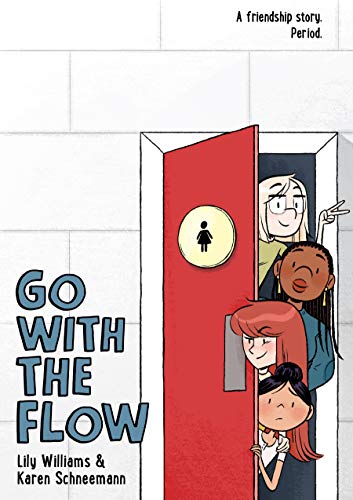
Go With the Flow - Lily Williams & Karen Schneemann


Three best friends Christine, Brit, and Abby befriend new girl Sasha when she gets her first ever period during the first week of classes at her new school. The three girls sashay Sasha into the bathroom when they notice blood on the back of her pants. Like so very many people before them they discover the vending machine for tampons and pads is "always empty" and they rightly point out that even if they are stocked, a person might not have the right change to purchase the needed item. Artist Abby uses the incident, and the injustices it highlights, to create a piece for the library art exhibit on "feminist voices and activism" she also starts a blog about menstrual equality. The school has plenty of money for new football equipment and uniforms, but won't provide basic essential hygiene products for those who menstruate. Abby just keeps getting madder and madder at the thought of it all and decides that the library exhibit just wasn't big enough to make a statement. Her "go big or go home" exploit involves graffiti and property destruction, and causes major embarrassment to Sasha who is still trying to live down her "Bloody Mary" nickname.

I have to say that as fed up as I am with the fact that the tampon vending machines at Bridgewater State University were all removed from the restrooms, it is more honest than having machines that are always empty. I do still wonder though how it is that the University can afford branded soap dispensers, but cries poor when I suggest that free menstrual hygiene products be made available.
Where the tampon vending machine used to be. Also visible is the basket I placed in the restroom two years ago where I put free tampons and pads I buy with my own money. Many anonymous others have also contributed products to this endeavor.


Branding is apparently very important for contributing to our Bears' sense of pride!


Wednesday, January 29, 2020

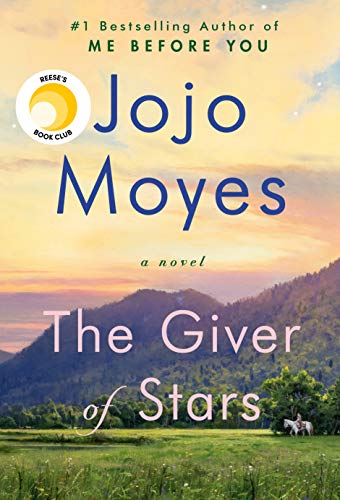
The Giver of Stars - by Jojo Moyes


People often share with me articles such as this one about the Kentucky Packhorse librarians, one of President Roosevelt's Works Progress Administration (WPA) projects. During the Great Depression these bad-ass librarians rode through rough mountain terrain in all weather in order to deliver books to rural Kentuckians. Moyes' novel tells the story of Margery O'Hare, Alice Van Cleve, Sophia Kenworth, Beth Pinker, Kathleen Bligh, and Isabelle (Izzy) Brady who took on the challenge of ensuring all in the mining town Baileyville could access reading materials.

Not everyone in town was happy about the set up. There were those who were not happy that Sophia a "colored" woman was working in the library. And some residents preferred that the librarians not bring any reading materials to their families (except perhaps the Bible), lest they "spread all kinds of crazy notions". Nevertheless even amid reports of 
wives no longer keeping house because they're too busy reading fancy magazines and cheap romances...[and] children picking up disruptive ideas from comic books 
the librarians took their charge seriously, and delivered materials to homes and schools across the mountainside. 

Newlywed Alice volunteered for the duty despite the vigorous objections of her husband and father-in-law who felt that as a proper woman she should stay home. The Van Cleve men, along with Pastor McIntosh and his sister Pamela also insisted that the horse riding was interfering with Alice's ability to have children. "It's like if you shake a jar of milk up too much, it turns sour. Curdles, if you like". Explains the clueless elder Mr. Van Cleve. Pastor McIntosh adds that he'd in fact read an article indicating as much. Although Alice is a bit naive about certain sexual matters, she is well aware of the real reason she hadn't conceived, and it had nothing to do with horseback riding. Rather than pointing out her husband's disinterest in sex she instead launches into an explanation of the importance of information literacy.
Knowledge is so important, don't you think? We all say at the library, without facts we really do have nothing. If I'm putting my health at risk by riding a horse, then I think it would only be responsible for me to read the article you're talking about. Perhaps you could bring it next Sunday, Pastor?
Alice further points out that
in England [whence she hails] nearly all well-brought up ladies ride. They go out hunting, jumping ditches, fences, all sorts. It's almost compulsory. And yet they pop out babies with extraordinary efficiency. Even the Royal Family. Pop, pop, pop!  
One of the more popular books in the library was a discretely requested manual called Married Love by one  Dr. Marie Stopes. The women who ventured to read the work found that their husbands spent less time at the honky tonks and more time at home "shorn of their usual short tempers".

It even worked for those women who preferred not to be married. Margery O'Hare read it twice and she and her beau Sven Gustavssen and made good use of the advice therein. Curious? You can read the whole thing here.

This book has something for everyone - murder, romance, intrigue, censorship, and more. My husband and I listened to the audio version. An excellent tale it is.

See also my post for That Book Woman for a children's picture book about the Packhorse librarians.


Monday, January 27, 2020

Falter: Has the Human Game Begun to Play Itself Out - by Bill McKibben


Some might call this book alarmist, but since McKibben called it on global warming back in 1989 when he wrote The End of Nature I'm not going to ignore his warnings here. Exploring Artificial Intelligence (AI), biotech, the billionaire class, and genetic engineering McKibben looks at how these things are part of a symbiotic relationship leading to a dystopic end of life as we know it. He pulls no punches as calls the villians out by name.

Writer Ayn Rand, author of The Fountainhead, and Atlas Shrugged and a darling of conservatives, is given a fair bit of print in this work. McKibben points out that
The cult of Ayn Rand extends far beyond the richest and most powerful. When the Modern Library asked readers in 1998 to catalogue the greatest books of the twentieth century...Atlas Shrugged and The Fountainhead were ranked one and two. Plenty of readers might have agreed with Barack Obama, who described Rand's work as "one of those things that a lot of us, when we were 17 or 18 and feeling misunderstood, we'd pick up". But plenty of others have never put her down. One biographer described her as "the ultimate gateway drug to life on the right." 
We may be able to take some solace that three of Rand's titles also show up on Goodreads list of Books You're Ashamed to Admit You Read.

Wednesday, January 15, 2020

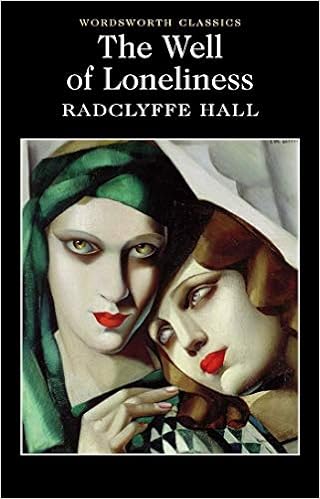
The Well of Loneliness - by Radclyffe Hall


Originally published in 1928, and promptly banned in England, this fictionalized account of the author's own life was cutting-edge lesbian writing in its day.

Born into wealth and privilege Stephen (her parents wanted a son) nevertheless has a difficult time growing up realizing that she is somehow different from her peers. As an adult she recognizes her desires, and is asked to leave the family estate (Morton) by her un-understanding mother. She had shared a love of books with her father, Sir Philip, who "had one of the finest libraries in England". Before his early death the two had read and discussed literature together. She also discovered after he died that he had divined his daughter's inclinations from having read the works of Richard Freiherr von Krafft-Ebing whose work, with her late father's marginalia, was kept on a special bookcase in his study.

Eventually Stephen settles in Paris with her partner Mary who is very much interested in Stephen's earlier life, although she would never welcomed in Morton
Mary would want to be told about Morton...she would make Stephen get out the photographs of her father, of her mother whom Mary thought lovely...Then Stephen must tell her of the life in London, and afterwards of the new house in Paris; must talk of her own career and ambitions, though Mary had not read either of her (Stephen's) novels-there had never been a library subscription.
 There was no "subscription" necessary for me to read Hall's book. I checked it out with my library card at the free public library in my town.

Tuesday, January 14, 2020

Masked by Trust: Bias in Library Discovery - by Matthew Reidsma


In the spirit of Algorithms of Oppression this book provides insight into how search engine results are generated. Going beyond Google, which may "customize" results for individual users, Reidsma also explains how library databases aren't necessarily without prejudice either, even though all users will see the same results if they enter the exact same search. Auto-suggestions can likewise shape our thinking in ways we may not have anticipated. All search engines are working on algorithms that were created by people (mostly young, white men). Their own biases will necessarily become part of the algorithm, even if they do not intend it.

Reidsma cites Bonnie Nardi and Vicki O'Day's work to suggest that we rethink the metaphor of library tools to a "library ecology".
The thing about the ecology metaphor is that it highlights the interconnectedness of all these different things coming together in one place. It emphasizes the co-evolution of technology and people. Its [sic] about people and tools together.
Perhaps the most  useful reason for dropping the tool metaphor is that tools require convergent thinking. You cannot create a tool with divergent thinking, where many possibilities exist...
...by switching our focus to seeing our technological systems as ecologies, and thus using divergent thinking to address the design and engineering of these systems, we can move beyond the limitations of tool-based thinking and design systems that are made to be used by diverse people.
This gave me a bit to ponder, and will change the way I teach people to think about and use our databases.

Friday, January 10, 2020

I Like the Library - by Anne Rockwell


The publication date on this book about a child visiting the library is 1977. The illustrations have a nice '70s vibe to them - teens wear cool striped pants and flowered skirts, and there is a clear attempt at including diverse people in the library, including a male children's librarian.

Other telltale '70s details include the viewing a filmstrip and listening to a cassette, selection of a record to play on a "phonograph player" at hom,e and the use of  book record cards.

The unnamed narrator is working on learning to write his name so he can get his own library card.